When we moved to Stockholm in 2009 it was because Tue got a scholarship for doing a post-doc at Stockholm University. The scholarship was initially for 1 year, but it was expected easily to be extended to a second year (and indeed it was). Further extension is not an option. There are two primary reasons for this: for one thing one can only be a tax exempted researcher in Sweden for 2 years; secondly it is not legal in Sweden to hire someone temporarily for more than 2 years (i.e. if a person were to be hired by the university for more than 2 years this person would have all the legal rights of a permanent employee - and in Sweden it is not easy to fire permanent employees).
All in all this means that since shortly prior to Ursula's birth - for the first time since 1995 - Tue has been what is in this day and age known as employment seeking. It has be said, though, that employment hasn't been sought particularly intensively yet as parenting has been the top priority (well, we also moved again - it all takes time).
Obviously there are advantages to being two parents at home. Everyday live, to mention just one aspect, is more managable with an extra pair of hands around the house. Another advantage is that it is relatively unproblematic to go to Jutland for half a month visiting the extended family. In this way most of our relatives have now met Ursula even though we don't live close to any of them.
Showing posts with label trips. Show all posts
20 October 2011
14 August 2011
Lunch with a view (part 2)
These weeks we are spending most of our time on two things: 1) Ursula and what surrounding issues 2) moving. But there has to be time for enjoying life as well so when we recently got up to a sunny morning after a couple of days with heavy rain we decided to go up the Kaknäs tower again. We had been talking about going up the tower already last summer and now that we had been up there in the winter we were even more curious to see Stockholm from above clad in green instead of clad in white.
Ursula was once again very good at travelling by bus and even let the grown-ups eat their lunch before she wanted food herself.
And in August it is significantly less cold for the fingers to capture the view.
18 June 2011
Countryside Street Art
06 June 2011
Snake's Head (Fritillary)

Our trip to Danmark actually started somewhere else in the vicinity of Uppsala: on Uppsala Kungsäng (Kungsängen in this context is read as Kungs-ängen, that is King-meadow - not to be confused with the Swedish bed stores Kung-sängen, 'the King bed'). We had read that in late May this meadow offers the view of lots of blooming snake's heads (in Swedish known as kungsängslilja, 'king-meadow-lily'). Truth be told the experience didn't have quite the grandeur we expected: the flowers are very pretty, but we had allowed ourselves to expect a virtually purple meadow...

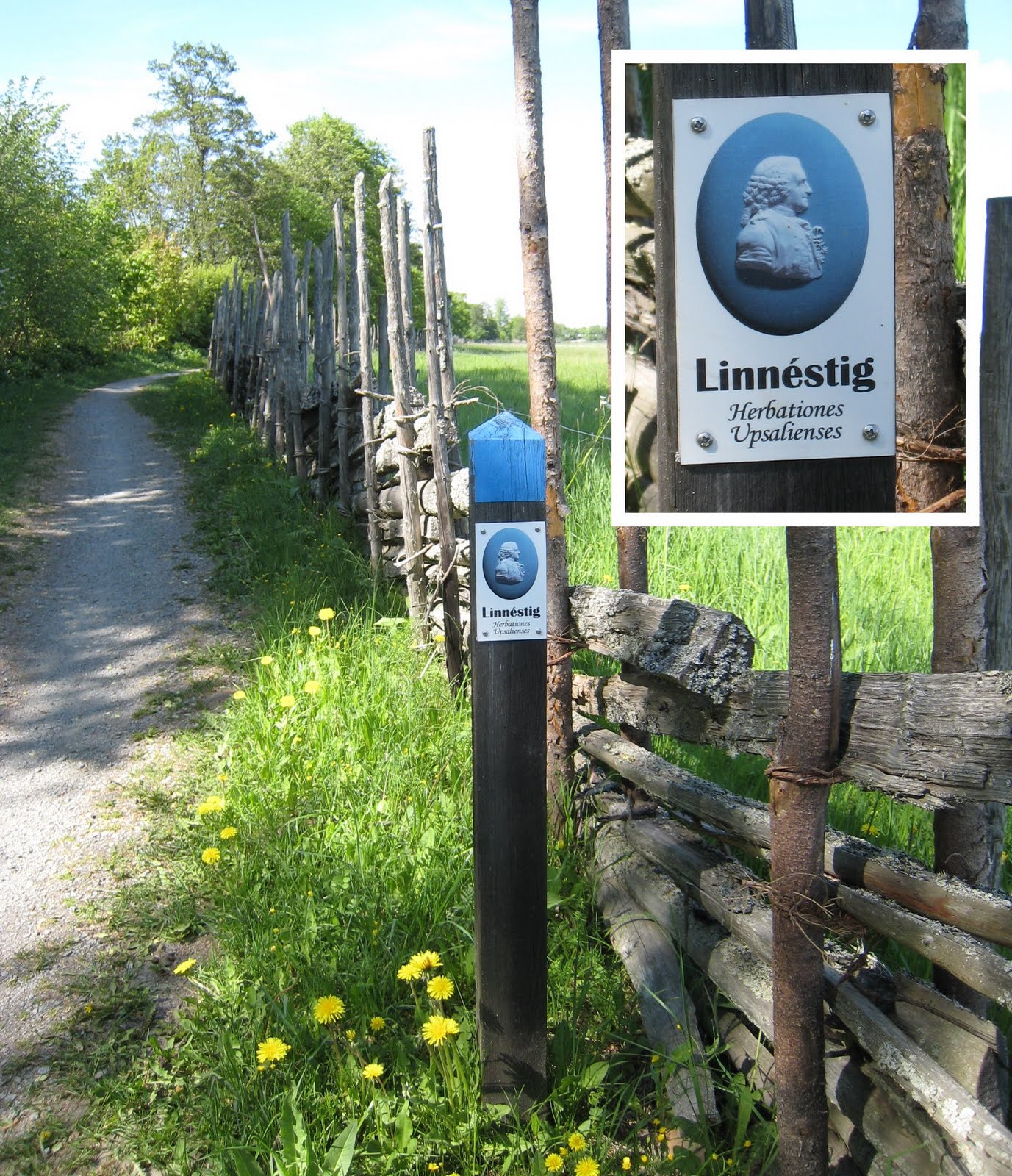
As with everything else related to botany in this country we were able to find traces of this gentleman:
04 June 2011
And then we went to Danmark

That is the village of Danmark[1] just outside Uppsala. Danmark is close to freeway E4 so even though we only recently learned that the village there is called Danmark we had previously noticed the church ('Church of Danmark').

[1] Yes, Danmark is the name for Denmark in both Danish and Swedish.
28 May 2011
Bottled mail
When we got off the boat in Stämmarsund on Blidö we discovered a mailbox of a kind we had never even anticipated finding: a message-in-a-bottle-box!
22 May 2011
Blidö
When Kirsten and Steen came to see us in Stockholm again recently we planned a trip on the water a sunny day in May.
We set the course for Blidö in order to try out the northern parts of the Stockholmian archipelago.
As it turned out there was a small glitch in our planning. The day before our trip we called Blidö Wärdshus to ask if they would be the day we went to Blidö. We were told they would be - but when we got out there that turned out to be a misunderstanding. So there we were, lunch hungry, no open restaurants and with 3-4 hour till the next boat departing Blidö. Fortunately the weather was excellent, so we tried to relax and make the best of it.
Nice spot for relaxing with a book..
We set the course for Blidö in order to try out the northern parts of the Stockholmian archipelago.
As it turned out there was a small glitch in our planning. The day before our trip we called Blidö Wärdshus to ask if they would be the day we went to Blidö. We were told they would be - but when we got out there that turned out to be a misunderstanding. So there we were, lunch hungry, no open restaurants and with 3-4 hour till the next boat departing Blidö. Fortunately the weather was excellent, so we tried to relax and make the best of it.
Nice spot for relaxing with a book..It turned out there was a bus from Blidö to Norrtälje one hour earlier then the next boat departure - our stomachs dictated that we take that bus. It was an interesting little bus ride: In order to reach the main land the bus crossed water no less than twice with the typical small yellow car ferries (from Blidö to Yxlan and onwards from Yxlan to Furusund) and 6 bridges (Furusund-Svartnö-Humlö-Idö/Nässelgrundet-Storö-Solö-main land).
Google maps: Trip from Blidö (lower right corner) to the main land (upper left corner)
Click the map for a larger version
Once in Norrtälje we made haste in getting a meal (late lunch/early dinner) in a pub before taking a much more boring express bus from Norrtälje to Stockholm (Freeway - Yaaaaaaaaaawn).
Google maps: Trip from Blidö (lower right corner) to the main land (upper left corner)Click the map for a larger version
Once in Norrtälje we made haste in getting a meal (late lunch/early dinner) in a pub before taking a much more boring express bus from Norrtälje to Stockholm (Freeway - Yaaaaaaaaaawn).
12 May 2011
Trip to Sörmland
We had decided to spend Easter this year making a small trip of Södermanland, or Sörmland as it is popularly known. And where is Sörmland? The short answer is that Sörmland is immediately south of Stockholm. The long answer needs to point out that Sweden can be divided in two different ways: in the 25 traditional provinces (landskap in Swedish) that today only have historical and cultural significance, and in the 21 counties (län in Swedish) that make up the administrative division of Sweden. The old province Sörmland (Sudermania in Latin) consists of Sörmland county and the parts of Stockholm county that are south of lake Mälaren.

One of our primary destination was Stendörren ('The stone door') natural preserve where a couple of islets and skerries are connected by wooden bridges so that one can visit the archipelago by foot. Fortunately the Easter weather was perfect for such outdoor activities.

Our trip continued to the nearest town, Nyköping ('New market town'), which is the capital of Sörmland county and turned out to be one of the nicer Swedish countryside towns we've visited. By the local stream, Nyköpingsån, we found this monument for one of the city's proud sons.

We decided to try something new and booked one night at Yxtaholm castle just outside of Flen. Although certainly picturesque there on the Yxtaholm islet between lakes Yxtasjön and Långsjön, it was more what we'd call a manor house than a castle.

In Mariefred by the shore of lake Mälarens we found Gripsholm castle which fits our expectations for a castle much better.

We also noticed a few pieces of cultural heritage reminding us that the area was populated already in the 11th century (translation and a few notes grabbed from the plaques posted next to the stones).

[1] giving the eagle food is a poetic term for killing enemies.
[2] Serkland, land of the Saracens land, presumably refers to an area by the Caspian Sea.
Tola had this stone raised to commemorate her son Harald, brother of Ingvar. Ingvar is mentioned in the Icelandic sagas as Ingvar the travelled. Ingvar's fateful expedition through Russia to the Caspian Sea is said to mentioned on almost 30 runestones in the valley around lake Mälaren.


One of our primary destination was Stendörren ('The stone door') natural preserve where a couple of islets and skerries are connected by wooden bridges so that one can visit the archipelago by foot. Fortunately the Easter weather was perfect for such outdoor activities.

Our trip continued to the nearest town, Nyköping ('New market town'), which is the capital of Sörmland county and turned out to be one of the nicer Swedish countryside towns we've visited. By the local stream, Nyköpingsån, we found this monument for one of the city's proud sons.

We decided to try something new and booked one night at Yxtaholm castle just outside of Flen. Although certainly picturesque there on the Yxtaholm islet between lakes Yxtasjön and Långsjön, it was more what we'd call a manor house than a castle.

In Mariefred by the shore of lake Mälarens we found Gripsholm castle which fits our expectations for a castle much better.

We also noticed a few pieces of cultural heritage reminding us that the area was populated already in the 11th century (translation and a few notes grabbed from the plaques posted next to the stones).

They fared like men - far after gold
and in the east - gave the eagle food[1]
They died in the south - in Serkland[2]
and in the east - gave the eagle food[1]
They died in the south - in Serkland[2]
[1] giving the eagle food is a poetic term for killing enemies.
[2] Serkland, land of the Saracens land, presumably refers to an area by the Caspian Sea.
Tola had this stone raised to commemorate her son Harald, brother of Ingvar. Ingvar is mentioned in the Icelandic sagas as Ingvar the travelled. Ingvar's fateful expedition through Russia to the Caspian Sea is said to mentioned on almost 30 runestones in the valley around lake Mälaren.

Hälgulv (?) and Öulv they had this stone raised
in memory of their brother Kätilmund and
(built) a bridge in memory of Soma, their mother.
But Brune (?), her brother, carved (the runes)
in memory of their brother Kätilmund and
(built) a bridge in memory of Soma, their mother.
But Brune (?), her brother, carved (the runes)
30 January 2011
Geyser
We were standing in the tourist office in Napa when we saw a postcard picturing California's 'Old Faithful' Geyser. We discovered that this geyser (which is quite a bit smaller than the more famous one in Wyoming of the same name) should be located just outside of Calistoga in the northern end of the Napa valley, and that it should erupt every half hour on average. We estimated that we had a decent chance of making it before sunset and set course for Calistoga up through the Napa valley.

It was quite easy to find the geyser, which is located right next to Chateau Montelena - the vineyard that was part of putting California on the wine list/map worldwide in the 1970's when their Chardonnay won a wine tasting in Paris beating a long list of French white wines.

We did make it before sunset, but in the late afternoon there wasn't all that much sunlight in the valley.
On the other hand it turned out that the geyser erupts a much more often in the winter time, just about every five minutes allowing us to see it a handful of times before total darkness fell.

It was quite easy to find the geyser, which is located right next to Chateau Montelena - the vineyard that was part of putting California on the wine list/map worldwide in the 1970's when their Chardonnay won a wine tasting in Paris beating a long list of French white wines.

We did make it before sunset, but in the late afternoon there wasn't all that much sunlight in the valley.
On the other hand it turned out that the geyser erupts a much more often in the winter time, just about every five minutes allowing us to see it a handful of times before total darkness fell.
29 January 2011
Elephant seals
Our New Year's trip to California included - true to habit - a drive along a stretch of Pacific coastline and - likewise true to habit - a stop just outside of San Simeon. Here is a beach which is popular with Northern Elephant Seals (which have previously mentioned briefly).

Despite having stopped at this particular beach numerous times in the past this was our first time stopping there around New Year. We hadn't been there very long before we sensed that this was a very special time of the year: Excited cheers from the crowd of (human) onlookers and a sudden intensification of the activity amongst the gulls on the beach is apparently the typical way of welcoming a newborn elephant seal.

Newborn elephant seals weigh a 'mere' 60-80 lbs and their skins looks funnily wrinkled and loose, but over the 4 weeks of nursing they can grow to 300 lbs after which their skin looks much smoother ('filled out' in a sense) like on the adult elephant seals.

At that time the pup is left behind by the mother who mates again before going out to sea. In anticipation of mating the large males are busy during this time marking their territories on the beach.

After watching the elephant seals we seated ourselves in the rental car to eat a bit of bread before driving further. There was a bright gull who appeared to know that humans in car with bread meant there might be a chance of getting a bite - so we had company watching us intently through the windscreen from the bonnet until we started the engine and pulled out of the lot.

Despite having stopped at this particular beach numerous times in the past this was our first time stopping there around New Year. We hadn't been there very long before we sensed that this was a very special time of the year: Excited cheers from the crowd of (human) onlookers and a sudden intensification of the activity amongst the gulls on the beach is apparently the typical way of welcoming a newborn elephant seal.

Newborn elephant seals weigh a 'mere' 60-80 lbs and their skins looks funnily wrinkled and loose, but over the 4 weeks of nursing they can grow to 300 lbs after which their skin looks much smoother ('filled out' in a sense) like on the adult elephant seals.

At that time the pup is left behind by the mother who mates again before going out to sea. In anticipation of mating the large males are busy during this time marking their territories on the beach.

After watching the elephant seals we seated ourselves in the rental car to eat a bit of bread before driving further. There was a bright gull who appeared to know that humans in car with bread meant there might be a chance of getting a bite - so we had company watching us intently through the windscreen from the bonnet until we started the engine and pulled out of the lot.
16 January 2011
Revisiting California

When we left California we thought we would definitely be back soon - but as it turned out it would be almost 3 years before we made it. Over Christmas we were a little worried to hear about massive rain in Los Angeles. Fortunately the rain stopped before we flew in, so we were able to enjoy a bike ride on the beach in pleasant weather. At the same time we could marvel at the backdrop of snowcapped mountains.

In addition to sunshine and grand nature, California - as always - also had a few interesting signs to offer..
20 November 2010
Tallinn

Lisbeth has been wanting to cross the Gulf of Finland for quite a while, so when her job took her to Helsinki once again she booked a ticket to Tallinn with Viking Line.


Tue obviously wasn't with her in Helsinki but he was able to fly from Stockholm to Tallinn so we could explore the old town of Tallinn together.


The etymology of the name Tallinn is debated, but one of the most widespread theories is that Tallinn derives from Taani-linna which means 'Danish City' or 'Danish Castle' in Estonian. As is well-known the Danes took the city on June 15 1219 in the famous battle during which legend has it that Dannebrog fell down from heaven and inspired fighting spirit in the Danish troops. After this victory Valdemar II decided that this flag should henceforth be the flag of Denmark.


Keeping to the historical aspect of the city we may mention that Tallinn also boasts a pharmacy that has been running for at least 588 years.

In Estonia one uses the Estonian kroon (yes, that is essentially the same name as 'kroner' - the name of currencies widely used in Scandinavia) and it wasn't until our last day there that we discovered that they have coins. Notes are by far the most used as they have notes all the way down to 2 Estonian kroon (being equivalent of some $0.17 at the current exchange rate).
Beware of low-flying purse snatchers - Estonian mailboxes - the 'watering holes' of the city are easily recognisable07 November 2010
Fall trip to Germany

Last time we went to Germany we had already made plans for another trip.
More specifically to go to Munich to visit Matthias with whom Tue shared his laboratory in California in 2004. That's quite a while ago by now, so a few things have happened since then for both parties: Most significantly for Matthias he has married his Gesche and they have two kids (and for Tue the most interesting part is that Lisbeth has come into his life since last time he saw Matthias).The weather really wasn't all that nice during the October weekend we were in Munich, but to try to make for it somebody (and no, we do not know who) had put up a large Danish flag on the tower of St. Peter's church in central Munich. Despite the weather there were a lot of local surfers out on the man-made Eisbach river in The English Garden.
30 September 2010
The historic route

From Uppsala one can go north on a road that an ordinary road map will designate simply as route 272. Where route 272 ends one can continue north on route 83 - all the way to Ånge, some 90 km (~50 miles) west of Sundsvall. This way is believed to have been used as a road for at least 2000 years, which is why it is known as 'the historic route' - and why it has its own homepage.

We had heard that it was supposed to be a beautiful journey through Swedish landscapes and had also been talking a little about renting a car to drive some of the route (the entire trip is 400 km (~ 250 miles)). However, it wasn't until we discovered that the route passes through the Swedish town with the incredibly beautiful name Harbo, that the planning got serious.

In the end we decided on another road trip with our faithfully returning (summer) camp visitor.

Just outside Harbo we made a stop in Kalvnäset natural reserve where we ate our cinnamon rolls by the shore of lake Tämnaren.
Later the trip continued to Gysinge where the route crosses the Dal River and passes through a corner of the national park Färnebofjärden. Here we had the opportunity to learn a little about hydropower by the aid of an interactive installation.

In the last hours of daylight we came the very pretty way over lake Storsjön into Sandviken (a city which sadly didn't inspire us to visit it for long) before we headed for Gävle and drove home along the coast.
Subscribe to:
Posts (Atom)